


What therapy at home involves, who Medicare covers, and what you pay.
Home health therapy is a licensed therapist provides in your home, ordered by your doctor, when it is hard for you to leave the house. Medicare covers it when you are homebound, need skilled care, and receive it from a Medicare-certified home health agency. If you qualify, you pay nothing for the visits.
Optimal Home Care is a Medicare-certified skilled home health agency that provides all three across the Denver metro.
Many home health plans use more than one kind of therapy. Each one has a different job.
What is home health physical therapy?
Home health physical therapy is skilled rehabilitation delivered in your home. A physical therapist comes to your living environment (house, apartment, independent/assisted living community). The physical therapist tests how you move and builds an individualized treatment plan around your living situation and your specific goals.
It is not a general fitness program. It treats a specific illness or injury, with measurable goals, under a plan of care your doctor signs.
Doctors often order physical therapy at home after:
Surgery, such as orthopedic surgeries such as a joint replacement, heart surgery, bowel/bladder surgeries, and more
A fall, or a growing fear of falling
A hospital stay that left you weak or immobilized
A stroke or brain injury
A new diagnosis impacting your ability to move like you normally do
A flare-up of a long-term condition such as heart failure, COPD, or Parkinson's disease
A home health physical therapy plan may include:
Strength and balance training
Walking practice, including on your own stairs
Safe ways to get in and out of bed, a chair, the car, etc.
Training with a piece of equipment, such as a walker, cane, or wheelchair
A home safety check for fall risks
A home exercise program and education/teaching for family or caregivers
With in-home physical therapy, the therapist works with the real thing YOU want to do safely again: your stairs, your bathroom, your favorite chair.
Occupational therapy and speech therapy at home
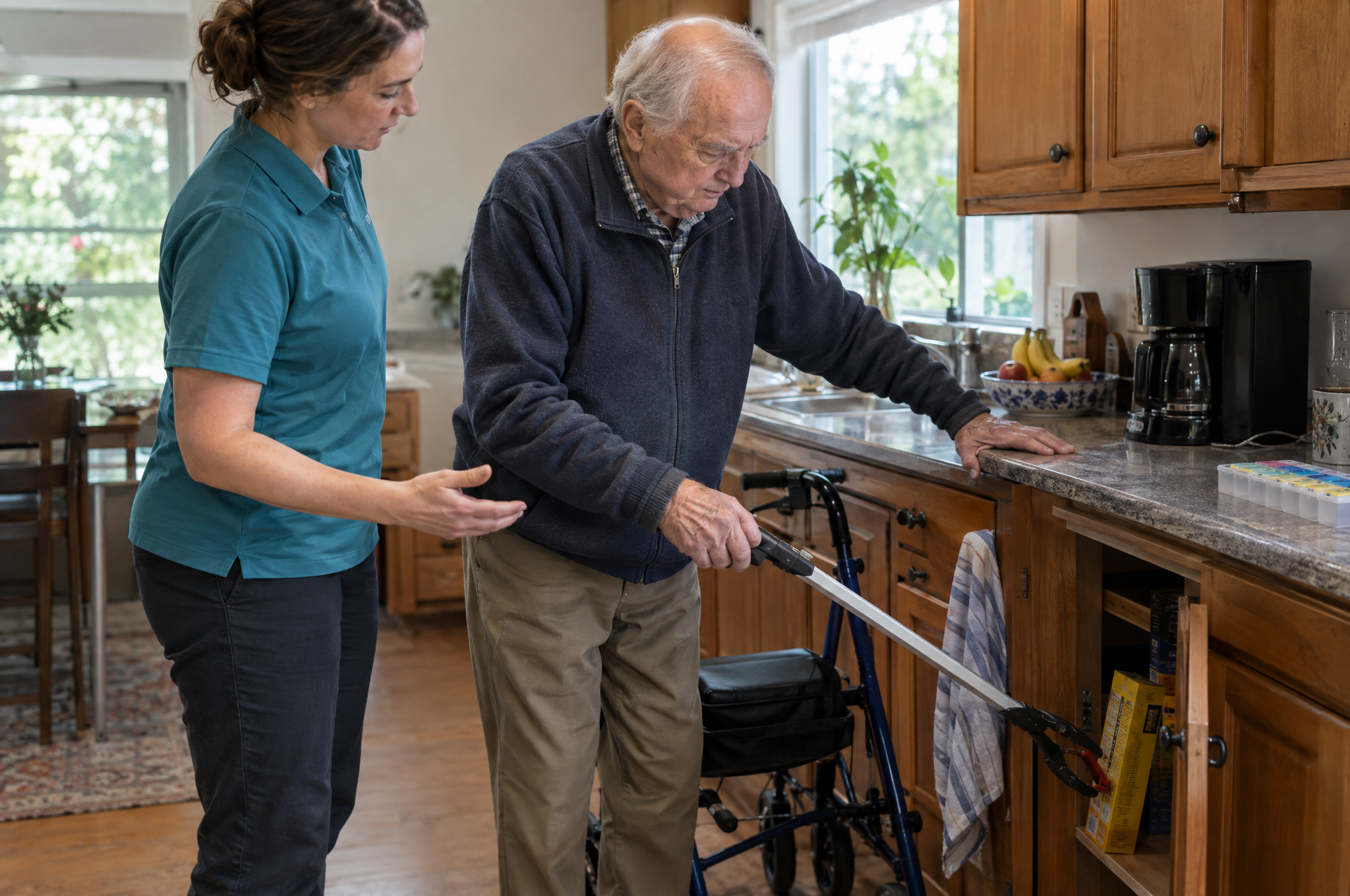
Home health occupational therapy
Occupational therapy helps you do daily tasks safely on your own. That includes bathing, dressing, cooking, using the toilet, managing your medications, and more. An occupational therapist may suggest new equipment, such as a shower chair or grab bars. The therapist can also teach ways to save energy and work on arm and hand use after a stroke or injury.
Medicare has one rule here that surprises families. Occupational therapy cannot be the only reason home health starts. Your doctor has to order it first along with skilled nursing, physical therapy, or speech therapy. After that, you can keep getting occupational therapy on its own, even when the other services have ended.
Home health speech therapy

Speech therapy at home is provided by a speech-language pathologist. Despite the name, it covers much more than speech. A speech-language pathologist can help with:
Trouble swallowing, also called dysphagia
Finding words or understanding language
A weak or quiet voice, which is common with diagnoses Parkinson's disease or a stroke
Memory, attention, and problem-solving skills that affect daily life
Does Medicare cover therapy at home?
Yes, when you meet the home health rules. Medicare Part A and Part B cover physical therapy, occupational therapy, and speech-language pathology services at home. The coverage rules come from the Medicare Benefit Policy Manual, Chapter 7. They are the same for every Medicare-certified agency.
How to qualify for home health therapy?
If you are asking, "Can I get therapy at home?", the answer depends on five conditions. You must meet all of them:
You are homebound. This does not mean bedbound. It means you need help from another person, or a device such as oxygen, a walker, cane, or wheelchair, to leave home. It can also mean your doctor advises against leaving. Either way, leaving home has to take a considerable and taxing effort. You can still go to medical appointments, religious services, and occasional short outings.
You cannot be currently driving.
You need skilled care. The therapy has to be complex enough that it takes a licensed therapist or licensed therapy assistant under the supervision of a licensed therapist, to perform tasks safely and effectively.
A doctor, nurse practitioner, clinical nurse specialist, or physician assistant orders and signs your therapy plan of care.
You have had a face-to-face visit with your Primary Care Provider (PCP) about the reason you need home health. It has to happen within the 90 days before care starts or the 30 days after.
A Medicare-certified home health agency provides the care.
Coverage is decided by your certifying practitioner and your plan of care. No agency can promise it. Our guide, Does Medicare cover home health care?, explains each rule in more detail.
You do not have to be getting better
Many people are told therapy has to stop once progress stops. That is not the Medicare rule. Coverage depends on whether you need the skills of a therapist, not on whether you are expected to improve.
Therapy to keep the abilities you have, or to slow a decline, can be covered. The test is whether it takes a therapist's skill to design the program or carry it out safely. This matters most for people living with chronic diagnoses such as Parkinson's disease, multiple sclerosis, dementia, and other conditions that cause a functional decline over time.
What home health therapy costs
Under Original Medicare, you pay nothing for covered home health therapy visits. There is no deductible and no copay for the visits themselves.
If your therapist recommends medical equipment such as a walker or wheelchair, you pay 20 percent of the Medicare-approved amount after you meet the Part B deductible.
Medicare Advantage plans must cover at least what Original Medicare covers. Each plan sets its own network and approval steps, so check with your plan. The plans we work with are listed on our accepted insurance page.
Home health vs. outpatient therapy
Medicare pays for therapy in two different ways.
Home health therapy is for people who are homebound. The therapist comes to you. Covered visits cost you nothing. It can be combined with skilled nursing and other home health services.
Outpatient therapy is for people who can leave home without great difficulty. It is covered under Medicare Part B, usually at a clinic. You pay 20 percent of the Medicare-approved amount after the Part B deductible. Some outpatient therapists travel to patients' homes. That is still outpatient therapy with outpatient costs.
You cannot use both home health and outpatient therapies at once. While you are under a home health plan of care, Medicare requires your therapy to come through your home health agency. After discharge, you can move to outpatient therapy. That handoff is common. When you are strong enough to get to a clinic, you are often no longer homebound.
If you are not homebound, an outpatient clinic or a mobile outpatient therapist is the better fit.
What to expect from in-home therapy visits
The first visit/evaluation: A therapist or nurse completes a full assessment of your health, your movement, and your home. Medicare requires this standard assessment, called OASIS, at the first home health visit.
Your plan of care: Your therapist sets individual and measurable goals at your evaluation with approval from your primary care physician, such as walking to the mailbox with a cane or climbing your stairs safely. The plan also lists how often each therapist will visit.
Regular visits: You practice the previously set goals with your therapist and may get exercises to do between visits. A licensed therapist assistant may provide some visits under your therapist's supervision.
Regular reevaluations: At least every 30 days, your licences supervising therapist, not an assistant, must retest your function and compare it to your goals to show a continued skilled need for therapy. Your doctor reviews the whole plan of care at least every 60 days.
Discharge: Therapy ends when you meet your goals, no longer need a skilled therapist, or are no longer homebound. Your therapist may leave you with a home exercise program to continue to do on your own.
Medicare does not set a fixed number of visits. How often you are seen, and for how long, comes from your plan of care based on skilled therapy needs and how you respond/progress with your skilled therapy.
Home health therapy in Denver with Optimal Home Care
Optimal Home Care is a Medicare-certified and Medicaid-certified skilled home health agency. We are Colorado-owned, established in 2004, and accredited by ACHC. Our CMS Quality of Patient Care rating is 3.5 stars, above the 3-star national middle.
Physical therapy, occupational therapy, and speech therapy are ordered on the same plan of care as our skilled nursing, wound care, and medical social work.
We provide in-home physical therapy, in-home occupational therapy, and speech therapy in Denver, Aurora, Centennial, Englewood, Greenwood Village, Cherry Hills Village, Glendale, Littleton, Lone Tree, Highlands Ranch, and Lakewood. For the full list of skilled services, see Medicare-certified home health care in Denver.
Home health physical therapy: common questions
Does Medicare pay for home health therapy?
Yes, when you are homebound, need skilled therapy, are under a plan of care signed by a doctor or other allowed practitioner, and use a Medicare-certified agency. Under Original Medicare you pay nothing for covered visits. Your certifying practitioner and plan of care determine coverage.
How do I get a therapist to come to my home?
Start with your doctor or with the hospital case manager if you are being discharged. They write the order. You have the right to choose any Medicare-certified home health agency that serves your area. You can also call an agency first, and they can work with your doctor's office to get an order.
Can you have home health and outpatient therapy at the same time?
Generally, no. While you are under a home health plan of care, Medicare requires therapy to be provided through your home health agency and you are homebound. After you are discharged from home health, you can continue with outpatient therapy.
How long does home health therapy last?
There is no set limit. Your doctor certifies home health for up to 60 days at a time and can recertify you while you still qualify. Many people need only a few weeks. Others need longer, including therapy to maintain function as long a skilled need is still required from a home health therapist.
Start home health therapy in Denver
Patients and families: Book your eligibility call with our home health team, or call 303-488-9999. We can walk through the Medicare rules with you and work with your doctor's office. Eligibility itself is determined by your certifying practitioner and your plan of care.
Discharge planners, case managers, and physicians: Send a therapy referral or call 303-488-9999 to reach home health intake. We verify benefits and confirm face-to-face documentation before the start-of-care visit.
Optimal Home Care, 4380 S. Syracuse St., Suite 600, Denver, CO 80237.
This page is general information for patients and families. It is not medical advice and does not establish coverage. Talk with your doctor about your own situation.
