

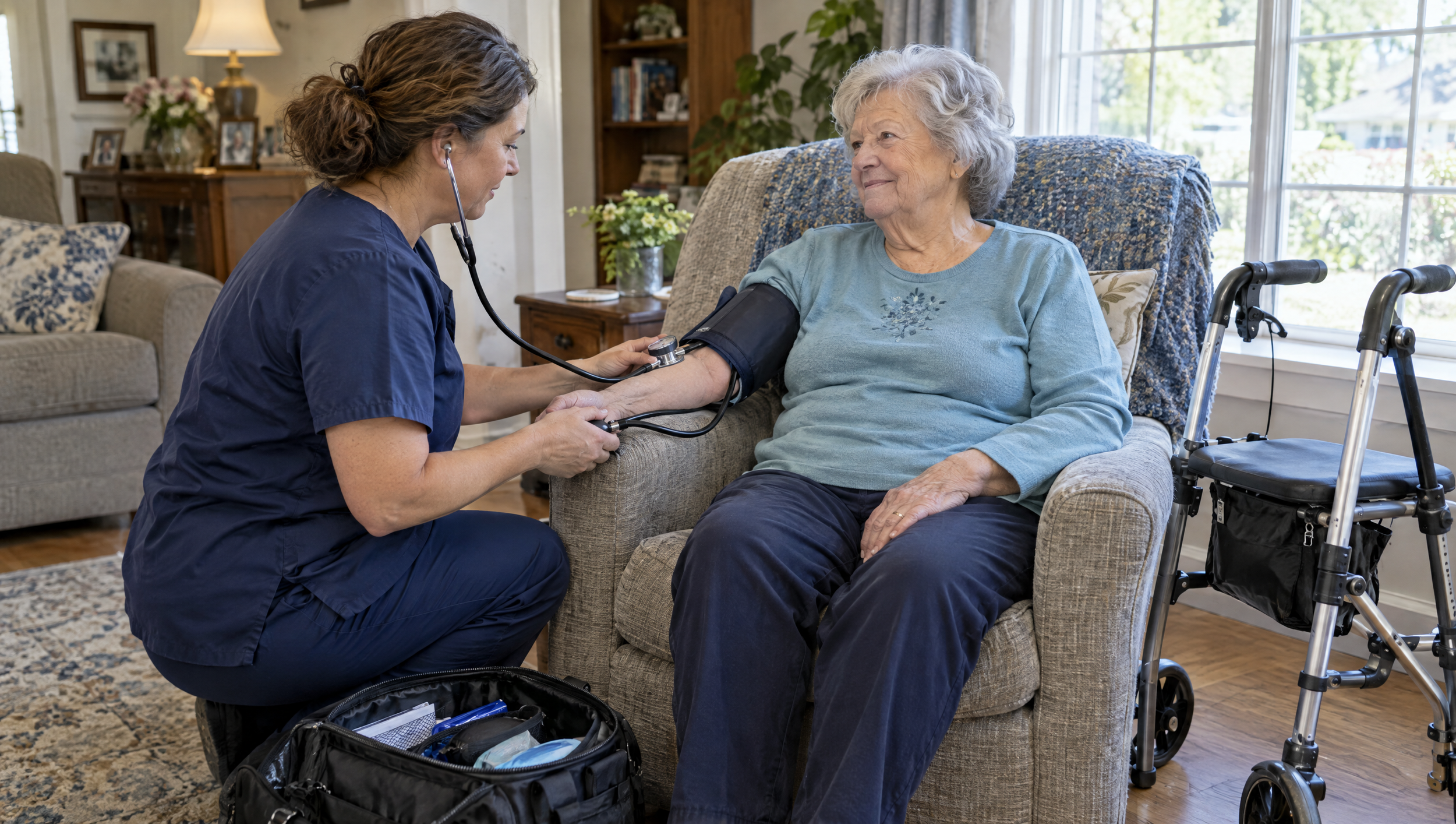
A plain-language guide to the kinds of care you can receive at home, who qualifies for each, and who pays.
Home health and home care sound alike, but they are not the same service. Home health is skilled medical care at home from nurses and therapists. A doctor orders it, and Medicare covers it when you qualify. Home care is non-medical help with daily life, such as bathing, meals, and companionship. Medicare doesn't pay for it when it is the only care you need, so many families pay out of pocket. Hospice is comfort-focused care for a person with a terminal illness, covered by Medicare Part A. Palliative care is symptom relief at any stage of a serious illness, given alongside regular treatment.
This page is general orientation, not medical advice. Your doctor decides what care is ordered.
Home health vs. home care: the short answer
The difference between home health and home care comes down to one question. Does the person need a licensed clinician for skilled services, such as a nurse or therapist, or do they need help with daily tasks?
Home health care
Medical care: skilled nursing, physical therapy, occupational therapy, speech therapy, and medical social work
Requires an order from a doctor or other allowed practitioner, such as a nurse practitioner or physician assistance
Delivered in scheduled visits throughout the week, not all-day shifts
Covered by Medicare, Medicaid, and most insurances when you meet the rules
Continues as long as you still qualify for skilled needs, with a review every 60 days
Home care
Non-medical help: bathing, dressing, meals, light housekeeping, rides, and companionship
No doctor’s order needed
Scheduled by the hour, from a few hours a week up to full-time
Usually paid out of pocket, or by long-term care insurance, Medicaid programs, or Veterans benefits
Continues for as long as you want and can pay for it
You may also hear home care called personal care, private duty care, companion care, or custodial care. Custodial care is the term Medicare uses for help with daily activities that does not require a licensed clinician.
A note on our name
Our agency is named Optimal Home Care, but we are a Medicare-certified skilled home health agency. Our nurses and therapists provide medical care under a doctor’s order. We do not provide stand-alone personal care, companion care, or live-in care. If daily help is the only thing you need, a licensed non-medical home care agency is the right call instead of a skilled home health agency.
What is skilled home health care?
Skilled home health care is care that needs the training of a nurse or therapist to be done safely and well. Common examples:
Wound care, IV medication, and injections
Teaching you to manage a new diagnosis, such as diabetes or heart failure
Physical therapy to walk and move safely after a fall, a stroke, or a joint replacement
Occupational therapy to relearn activities of daily living such as bathing, dressing, and cooking
Speech therapy for cognitive (memory), swallowing, or speech problems
Who qualifies for home health under Medicare
For Medicare to cover home health, all five of these must be true:
You are homebound. You are not currently driving. Leaving your home takes a lot of effort, and either you need help to do it, from another person or a device such as oxygen, a walker, or a wheelchair, or your doctor advises against leaving because of your condition. You can still leave for medical care and for short, occasional outings.
You need skilled nursing care or therapy.
The care is part-time or intermittent, not full-time.
A doctor or other allowed practitioner has seen you face to face, certifies that you qualify, and signs your plan of care.
The care comes from a Medicare-certified home health agency.
These rules come from the Medicare Benefit Policy Manual, Chapter 7. Coverage is decided by the certifying practitioner and the plan of care, not by the agency. Our guide to whether Medicare covers home health care walks through each rule in detail.
What home health costs
With Original Medicare, you pay nothing for covered home health visits. You pay 20 percent of the Medicare-approved amount for medical equipment such as a walker or hospital bed, after the Part B deductible. Medicare Advantage plans cover home health too, but they set their own networks and approval rules. Our accepted insurance page lists the plans we work with.
What is home care?

Home care is non-medical support that helps a person stay safe and comfortable at home. A caregiver may help with bathing, dressing, and using the bathroom, cooking, laundry, errands, rides to appointments, medication reminders, and companionship or supervision for a person with memory loss.
Home care does not include nursing, therapy, wound care, injections, or IV medication.
Who pays for home care
Original Medicare does not pay for home care when it is the only care you need. Home care is usually paid for in one of these ways:
Private pay, by the hour
Long-term care insurance
Health First Colorado, the state Medicaid program, through its home and community-based programs for people who qualify
Veterans benefits
Home health aide vs. caregiver
A home health aide works for a home health agency. The aide follows your plan of care and is supervised by a nurse or therapist. Medicare covers a home health aide only while you are also receiving skilled nursing or therapy. When the skilled care ends, the aide visits end too.
A caregiver from a home care agency is hired by you, for as many hours as you choose. No skilled service is required, and you or your long-term care coverage pays.
If you are searching for a home health aide in Denver, ask which one you need: an aide as part of doctor-ordered skilled care, or a caregiver for daily help.
How Colorado licenses home care agencies
Colorado licenses agencies in two classes through the Department of Public Health and Environment. Colorado uses the term home care agency for both, which adds to the confusion. A Class A agency may provide skilled health care and may also provide personal care. A Class B agency provides personal care only and may not provide any skilled service. Ask any agency which license it holds.
Home health vs. hospice
Home health and hospice both bring a care team to where you live. The difference is the goal.
Home health aims to help you recover, regain function, or manage a health condition, and you can keep receiving treatment meant to cure your illness.
Hospice is different:
The goal is comfort and quality of life when an illness can no longer be cured
A doctor certifies a life expectancy of six months or less if the illness runs its normal course
You choose comfort care instead of curative treatment for the terminal illness
You do not have to be homebound
Includes nursing, medications for comfort, medical equipment, aide visits, social work, chaplain care, and grief support for the family
Runs in two 90-day benefit periods, then unlimited 60-day periods, as long as you still qualify
Hospice is covered by Medicare Part A. You pay nothing for hospice care itself. Medicare allows a copay of up to $5 for each prescription for pain and symptom relief. You may also pay 5 percent of the Medicare-approved amount for inpatient respite care, a short facility stay that gives your caregiver a rest. Hospice does not cover room and board in a nursing home or assisted living community.
Hospice eligibility is determined by physician certification. Choosing hospice is not permanent. You can stop hospice at any time and go back to the insurance coverage you had before.
Our guide to choosing a hospice in Denver explains eligibility and the Medicare quality data in more depth.
Can you have home health and hospice at the same time?
Not for the same illness. Once you choose hospice, the hospice team provides all care related to the terminal illness, including nursing and aide visits at home. Medicare can still cover care for a health problem that is not related to the terminal illness. That situation is uncommon, and your hospice team will tell you what is and is not covered.
Hospice vs. palliative care
Palliative care is medical care focused on relief from the symptoms and stress of a serious illness. Hospice is one kind of palliative care, for the final months of life. The key differences:
Timing. Palliative care can start at any stage of a serious illness, even at diagnosis. Hospice becomes an option when a doctor believes life expectancy is six months or less.
Treatment. With palliative care, you can keep treatment meant to cure your illness. With hospice, the focus shifts to comfort.
Payment. Hospice is a defined Medicare benefit with almost no cost to the patient. Medicare has no separate palliative care benefit. Palliative visits are generally billed like other medical visits, so your usual deductibles and coinsurance apply.
Palliative care vs. home health is a different comparison. Home health is a Medicare benefit with specific rules, including being homebound. Palliative care is an approach to care, and a palliative specialist can work alongside your home health team.
Skilled nursing facility vs. home health
A skilled nursing facility is a place you stay, with nurses on site day and night. Home health brings skilled care to you in visits while you live at home. After a hospital stay, your discharge planner can explain both, and you have the right to choose your provider, though a Medicare Advantage plan may limit you to its network.
Which type of care do you need?
A few plain questions point to the right starting place:
A doctor ordered nursing or therapy, and leaving home is hard. Start with home health.
You need help with bathing, meals, or supervision, and no medical care. Start with home care.
You need both. Use home health for the medical care and skilled needs and add home care or family to help with daily tasks.
A serious illness is causing pain or other symptoms, and treatment is continuing. Ask your doctor about palliative care.
Treatment is no longer working or no longer wanted, and comfort is the priority. Ask about hospice. Eight signs it may be time for hospice care is a helpful next read.
Home health and hospice in the Denver area
Optimal operates two Medicare-certified agencies from the Denver Tech Center. Each is certified separately and has its own phone line.
Optimal Home Care is our skilled home health agency. It holds a CMS Quality of Patient Care rating of 3.5 stars, above the 3-star national middle. Learn more about Medicare-certified home health care in Denver.
Optimal Hospice Care is our hospice agency. It scores 10 out of 10 on the Medicare Hospice Care Index, against a national average of 8.8 and a Colorado average of 9.5. In the last three days of life, 75.8 percent of our patients received a visit from a registered nurse or medical social worker on at least two of those days. The national figure is 48.3 percent and the Colorado figure is 62.3 percent. Learn more about hospice care in Denver, CO.
Both Optimal Home Care and Optimal Hospice Care agencies serve Denver, Aurora, Centennial, Englewood, Greenwood Village, Cherry Hills Village, Glendale, Littleton, Lone Tree, Highlands Ranch, Colorado Springs, Loveland, Fort Collins, and Lakewood.
Frequently asked questions
What is the difference between home health and home care?
Home health is medical care at home from nurses and therapists, ordered by a doctor and covered by Medicare when you qualify. Home care is non-medical help with daily activities such as bathing, meals, and companionship, usually paid for privately.
Is home health the same as a caregiver?
No. Home health sends licensed clinicians for scheduled medical visits. A caregiver provides ongoing non-medical help by the hour. A home health aide can help with bathing as part of a skilled plan of care, but only while nursing or therapy is also being provided.
How many hours a day will Medicare pay for home health care?
Medicare sets a ceiling, not a schedule. Skilled nursing and home health aide visits together may add up to 8 hours a day and 28 hours a week. For a short time, your provider may approve up to 35 hours a week, still under 8 hours a day. Your plan of care sets the actual number of visits. Medicare does not cover 24-hour care at home.
Is palliative care the same as hospice?
No. Hospice is palliative care for the final months of life, when the focus has shifted from cure to comfort. Palliative care can begin at any stage of a serious illness and can be given along with curative treatment.
Talk with our team
Home health coverage is determined by your certifying practitioner and the plan of care. Hospice eligibility is determined by physician certification.
Home health, patients and families: Book a home health eligibility call or call Optimal Home Care at 303-488-9999.
Hospice, patients and families: Book a hospice eligibility call or call Optimal Hospice Care at 303-488-9998.
Discharge planners, case managers, and physicians: Start a referral with our team. For skilled home health referrals, call Optimal Home Care at 303-488-9999. For hospice referrals, call Optimal Hospice Care at 303-488-9998.
Optimal Home Care, 4380 S. Syracuse St., Suite 600, Denver, CO 80237. Optimal Hospice Care, 4380 S. Syracuse St., Suite 455, Denver, CO 80237. Colorado-owned since 2004, Medicare and Medicaid certified, ACHC accredited.
